Rowing is one of the oldest sports in the world, with evidence of rowing dating back to ancient Egyptian times. Long before it became a competitive sport, rowing was an essential means of transport, allowing people to travel across rivers, lakes and oceans, carrying goods, passengers and sometimes entire armies.
The sport was particularly important in ancient Greece and Rome, where rowing vessels known as galleys played a significant role in maritime trade and military operations. Large crews of rowers were needed to propel these vessels, making rowing an important skill in ancient naval warfare.
During the Middle Ages, rowing continued to be used for military purposes, with galleys remaining an important part of naval fleets, particularly around the Mediterranean. Rowing was also an everyday necessity for fishermen, traders and coastal communities. Over time, competition between boat crews began to develop, particularly among professional watermen who made their living transporting passengers and goods along rivers.
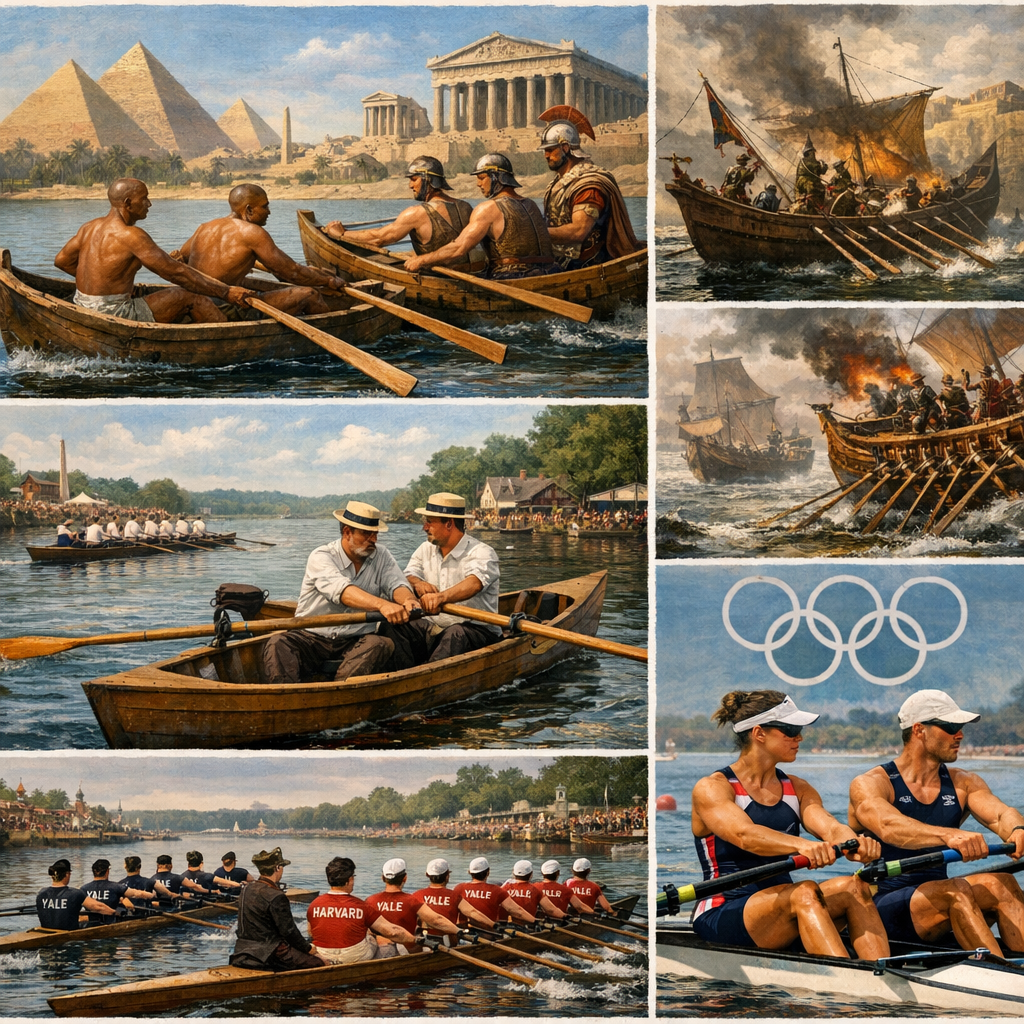
It was in England that rowing began to evolve into something closer to the organised sport we recognise today. During the 18th century, professional watermen on the River Thames regularly competed against each other, with races attracting considerable public interest. These men were highly skilled boatmen, and racing provided an opportunity to demonstrate their strength, speed and ability on the water.
By the 19th century, rowing had become a popular leisure activity, particularly among the upper classes and university communities. Leander Club was established in 1818 and remains one of the oldest rowing clubs in the world.
One of the most significant milestones in rowing history came in 1829, when Oxford and Cambridge universities competed in the first Boat Race on the River Thames. What began as a challenge between two university friends has grown into one of the most famous events in the rowing calendar.
The popularity of competitive rowing continued to grow, with the first Henley Royal Regatta taking place in 1839. Henley quickly became an important event in the rowing calendar, attracting crews from across Britain and eventually from around the world.
Rowing also began to establish itself in other countries, including Australia and the United States. The first intercollegiate rowing race in the United States took place in 1852 between Harvard and Yale, and the sport soon became a major part of American college athletics.
Australia also has a long and proud rowing history. Competitive rowing was taking place in the early 19th century, with organised regattas developing as the sport grew in popularity. Professional sculling became particularly popular, with Australian rowers achieving international recognition. In 1876, Ned Trickett became the first Australian to win the professional world sculling championship, helping put Australian rowing on the international map.
As the sport continued to develop, rowing became increasingly organised at an international level. The international governing body, originally known as FISA and now called World Rowing, was established in 1892 to oversee the sport and encourage international competition.
In the early 20th century, rowing became an Olympic sport. It was originally scheduled to feature at the 1896 Athens Olympic Games, but the events were cancelled because of bad weather. The first Olympic rowing competition eventually took place at the 1900 Paris Games. Since then, rowing has been a regular feature of the Olympics, with women’s events introduced in 1976 at the Montreal Games.
Today, rowing is a popular sport around the world, with millions of people participating at recreational and competitive levels. From school and university rowing through to club, masters and elite competition, the sport offers opportunities for people of all ages and abilities.
The boats and equipment have changed considerably over the years. Modern racing shells are lightweight and highly engineered, while advances in oar design, boat construction and training methods have helped athletes achieve performances that would have been difficult to imagine in the early days of competitive rowing. The sport now includes a variety of boat classes, from single sculls through to the eight, each requiring a combination of fitness, strength, technique and teamwork.
From its origins as a means of transport in ancient civilisations to the highly competitive sport we see at the Olympic Games and World Championships, the history of rowing is a rich and fascinating one. Yet, despite all the changes in equipment, training and competition, the basic principle remains the same: getting a boat from one point to another using nothing more than the combined effort of the people in it.
And perhaps that’s part of the enduring appeal of rowing. Whether you’re competing at an elite level, racing at your local regatta or simply enjoying an early morning row with your club, there’s something special about being out on the water and being part of a crew.
Guy Besley is the author of Beyond the Call: The Art of Being a Rowing Coxswain. If you'd like to learn more, it's available as a two-volume edition on Amazon.



0 Comments