In rowing, raw power is easy to admire. A big athlete pulling huge numbers on the erg looks impressive, and strength absolutely matters. But boats do not move on watts alone. They move when power, body weight, stroke rate, timing, and efficiency all come together. That is why power-to-weight, often expressed as watts per kilo, can be a better guide to boat-moving ability than raw power by itself.
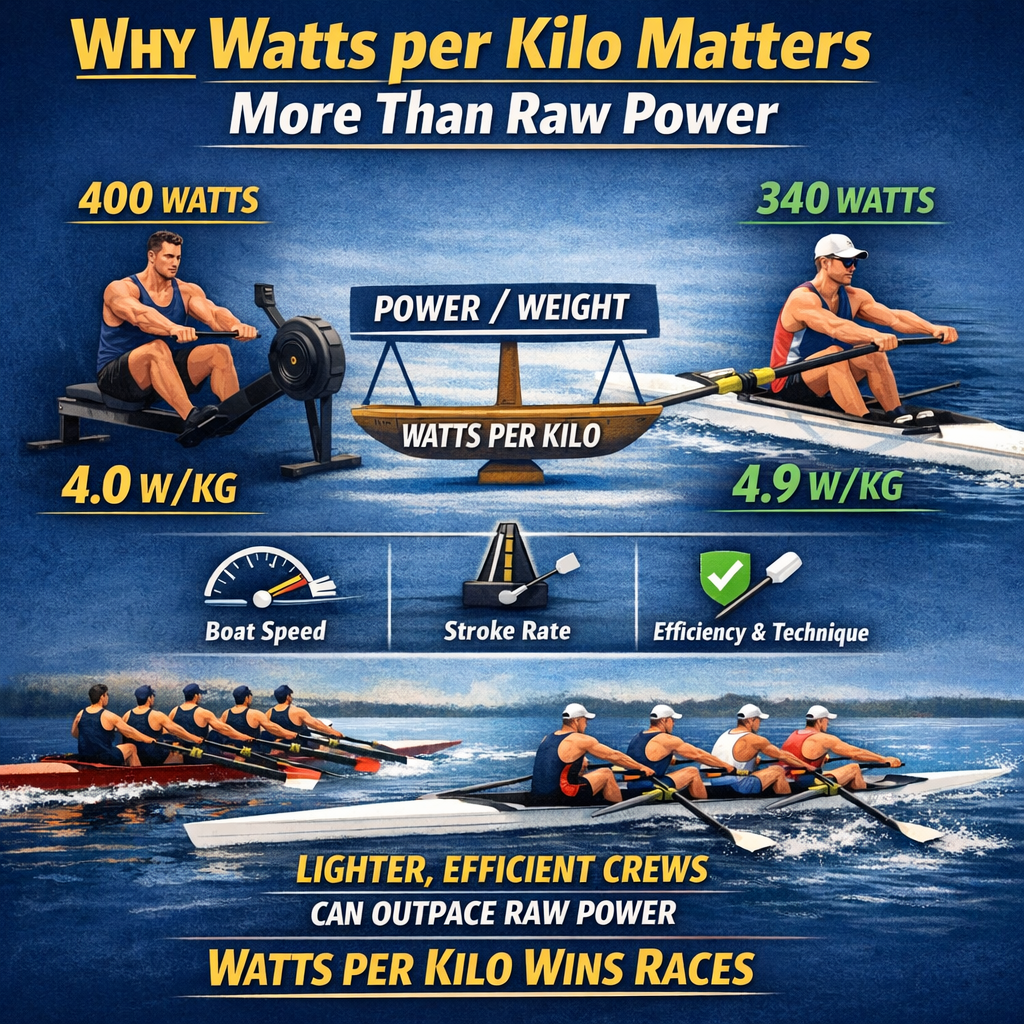
Why Watts per Kilo Matters More Than Raw Power
Cycling has made watts per kilo a familiar statistic, especially because climbing rewards riders who can produce high power without carrying unnecessary mass uphill. Rowing is different because the boat is supported by water rather than lifted against gravity in the same way. Even so, body weight still matters. Every kilogram in the boat has to be carried, accelerated, balanced, and moved efficiently through the water. A rower producing 400 watts at 100 kg is not the same as a rower producing 340 watts at 70 kg when you look at the whole crew and boat system.
Watts per kilo gives a more balanced view of how much useful power an athlete brings relative to the load they add. A heavier rower may produce a bigger erg score, but if that extra power comes with a lot of extra mass, the net benefit can be smaller than expected. This is especially important in bigger crew boats, where everyone must match rhythm, length, timing, and rate. A lighter athlete with excellent watts per kilo, clean technique, and the ability to row efficiently at higher rates may move a boat better than a heavier athlete who is strong but less efficient.
This does not mean heavyweight rowers are less valuable. At elite levels, many heavyweights are extremely powerful, technically sharp, and highly conditioned. But the key is whether the additional body mass is matched by enough additional boat speed. In practical terms, coaches and rowers should look beyond the biggest erg number and ask: how much power is being produced per kilo, how well is it converted into speed, and can it be sustained at race rate? Those questions often reveal more than raw watts alone.
Lighter Crews, Higher Rates, Better Efficiency
Lighter rowers often have an advantage when it comes to rating higher with control. Because they generally have less body mass to move up and down the slide, they can sometimes change direction more quickly and maintain a sharper rhythm without wasting as much energy. A higher stroke rate is not automatically better, but when it is technically clean, it can create excellent boat speed. A lighter, efficient crew that can rate well may maintain momentum more smoothly than a heavier crew that relies mainly on power per stroke.
This is where power-to-rate ratios become important. Rowing is not just about how hard each stroke is; it is about how much effective power is produced at a given rate while keeping the boat balanced and running. A crew that produces slightly less power per stroke but does so at a higher, more efficient rate may outperform a crew that produces large individual strokes but struggles with rhythm, recovery speed, or technical consistency. The best crews are not simply the strongest crews. They are the crews that combine power, rate, timing, and economy.
This point is particularly relevant for Masters rowing. Many Masters athletes are very strong and experienced, but body composition can vary widely. A heavier rower may feel they are adding value because they can pull big numbers, yet if some of that weight is not contributing to effective power, it may slow the boat more than they realise. This becomes even more noticeable when rowing with lighter, fitter athletes who can rate higher and move more efficiently. For Masters crews, improving watts per kilo through better fitness, body composition, technique, and rate control can often produce more speed than simply trying to become stronger.
Power matters in rowing, but power relative to body weight often matters more. Raw strength can win admiration, yet watts per kilo, efficient movement, and the ability to row well at race rate are what truly move boats. Whether in club rowing, competitive squads, or Masters crews, the best question is not “Who is the strongest?” but “Who helps the boat go fastest?”
And after all, we have seen lightweight crews beat heavyweight crews regularly.
Guy Besley is the author of Beyond the Call: The Art of Being a Rowing Coxswain. If you'd like to learn more, it's available as a two-volume edition on Amazon.



0 Comments